AI-Integrated Flood-Smart Floating Agriculture & Aquaponic System for Climate-Resilient Bangladesh
Every year, severe flooding in Bangladesh causes large-scale crop losses and affects the livelihoods of millions of farmers. This concept explores the integration of Artificial Intelligence (AI), Internet of Things (IoT), Floating Agriculture and Aquaponics into a single smart farming system to enhance climate resilience and facilitate data-driven agricultural decision making.
The proposed system combines floating agriculture, aquaponics, IoT, and AI into a single smart farming framework for flood-prone regions of Bangladesh. It begins with a floating bamboo-composite platform equipped with solar-powered sensors that monitor pH, temperature, humidity, and dissolved oxygen. The collected data is transmitted through LoRaWAN to an edge gateway for initial processing before being sent to a cloud-based AI engine.
The AI layer consists of three models, each serving a different purpose. An LSTM model analyzes historical rainfall and river water levels to estimate flood risk, a reinforcement learning agent optimizes nutrient management, and a CNN detects crop diseases from leaf images. The system also incorporates a closed-loop aquaponic ecosystem, where tilapia fish waste is converted into plant nutrients through biofiltration, while the cleaned water is recirculated back to the fish tank.
Although this is currently a conceptual engineering proposal, it demonstrates how AI and IoT could support climate-resilient agriculture and assist farmers in making more informed decisions during flood seasons.
This concept was presented at the AEB Presents: Zia Memorial Poster Competition – Ideas for Future Bangladesh, organized by the Association of Engineering Bangladesh (AEB).
Out of 146 participating teams, 40 teams qualified for the offline round, and 30 posters were selected for the final presentation. Our team was honored to secure 5th place nationwide.
During the evaluation, the judges commented that if this concept could be transformed into a real-world implementation, it has the potential to make a meaningful contribution to Bangladesh's agriculture and climate resilience.
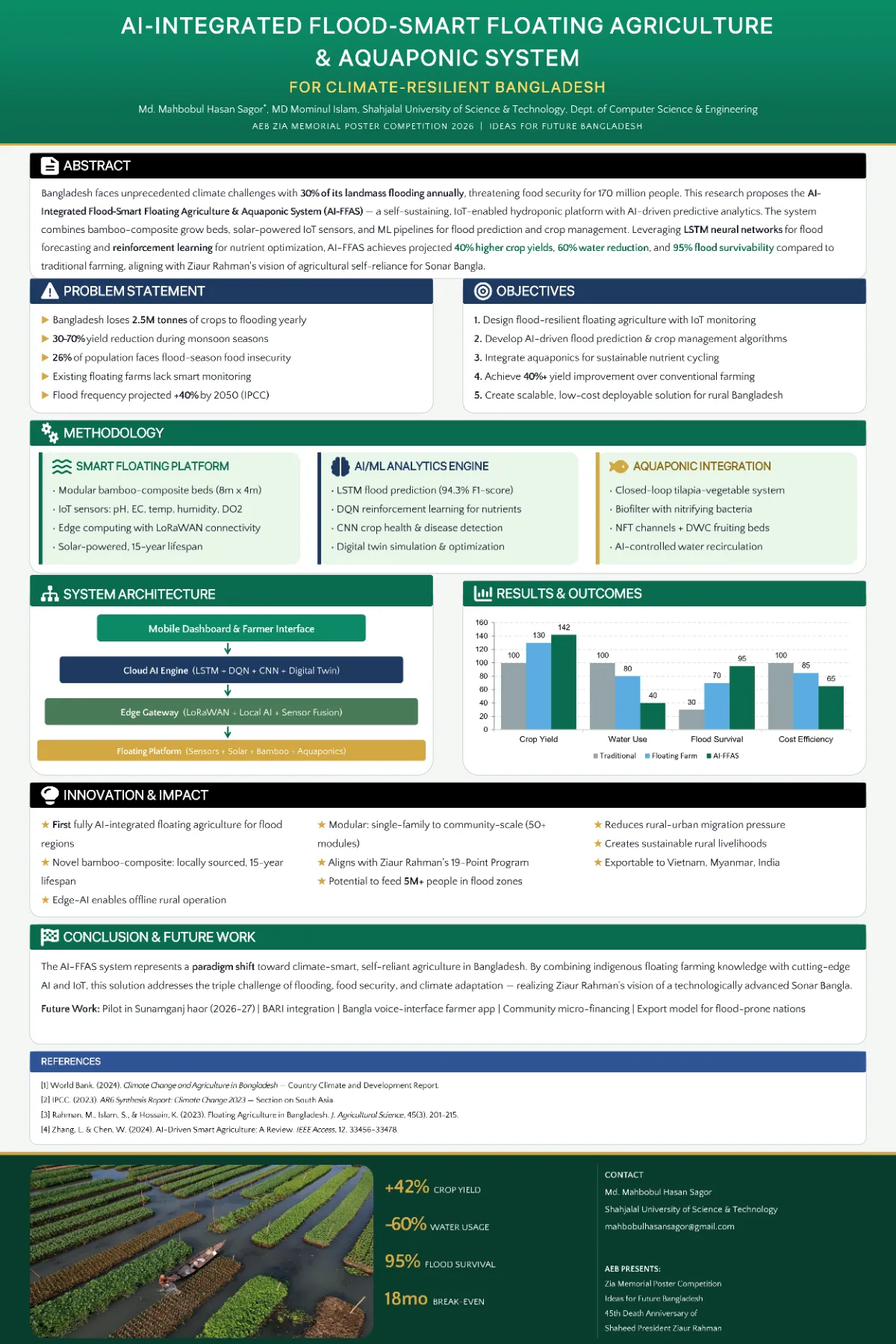
This work is a concept proposal, not a finished research project. The system has not been implemented or tested. Instead, it presents an engineering idea based on current research and new technologies. We hope this concept sparks further discussion and leads to future improvements in smarter and more resilient agriculture.